5 Proven Steps to Achieve Your Christ-centered Goals in 2026
Do you want to make a deeper impact in your relationship with God, your family, or your friendships? Do you desire to grow spiritually, become physically healthier, and steward your finances wisely?
SPIRITUAL DISCIPLINEGOD'S PLAN AND PURPOSE
Mildred White
1/2/20265 min read

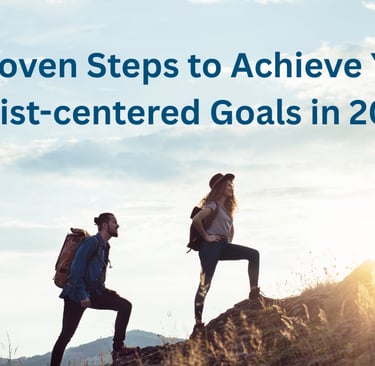
Setting goals is easy. Achieving them is another story.
The beginning of a new year is one of the best times to practice Christian goal setting. It’s a season of fresh starts—new calendars, new budgets, new routines, and renewed vision. But as believers, we are called to approach goal setting differently.
Faith-based goal planning isn’t about hustling harder. It’s about partnering with God.
“We can make our plans, but the Lord determines our steps.”
— Proverbs 16:9 (NIV)
While we may create plans, true success depends on God’s will, timing, provision, and purpose.
Jesus reminds us:
“I am the vine; you are the branches… apart from Me you can do nothing.”
— John 15:5 (NIV)
And Proverbs encourages us:
“Trust in the Lord with all your heart… and He will make your paths straight.”
— Proverbs 3:5–6 (NIV)
Instead of asking God to bless our plans, what if we asked Him what His goals are for us—and aligned our lives accordingly?
Below are five simple steps to achieve your goals in 2026 using a biblical approach that will help you align with God's purpose for your life.
Step 1: Prayerfully Evaluate Your Life
Before writing down any goal, pause and pray. Ask the Lord to help you reflect honestly on these key areas:
Faith and spiritual growth
Family and relationships
Career or business
Health and wellness
Finances and stewardship
Ask God:
Is there anything You want me to STOP doing?
Is there anything You want me to START doing?
Where are You leading me in this next season?
Personal, family, and career goals should always be placed before the Lord. Ask Him if there is something specific He wants you to change or pursue in the coming year.
James Hansberger, a distinguished wealth advisor at Morgan Stanley and author of Nice Guys Finish Rich, observed that what mattered most to people near the end of their lives were faith, family, friends, fitness, and finance—in that order. He developed the “5 Fs” framework to guide holistic life planning and emphasized the importance of prioritizing these areas before financial success.
Verne Harnish later incorporated this framework into the One Page Personal Plan (OPPP) in his book Scaling Up. You can read more here.
If you choose to follow the 5 Fs framework, start with your relationship with the Lord. This may look like spending consistent time in prayer and Bible study—or as simple as committing to regular church attendance with your family.
Step 2: Define Your Goal Using the SMART Principle
Once you’ve prayed and reflected, clearly state your goal using the SMART goal principle. This ensures your goal is specific, trackable, and realistic.
Specific: What exactly do I want to achieve?
Measurable: How will I track my progress?
Achievable: Can this fit into my daily, weekly, or monthly schedule? Do I have the right skills and resources to reach my goal?
Relevant: Why does this goal matter? Is this where the Lord is leading me?
Time-bound: When do I want to complete this goal?
The clearer your goal is, the easier it becomes to take consistent action and stay aligned with God’s purpose. If you need more information on how to apply the SMART goal principle, read the blog post How to Use SMART Goals to Succeed in 2026.
Step 3: Identify Hurdles and Create God-Honoring Solutions
Every goal has obstacles. Anticipating them ahead of time allows you to respond wisely rather than quit prematurely.
Common Hurdles and Practical Solutions
Resistance to change or giving up too early
Change requires shifting habits and mindsets. Many people lose momentum when discomfort sets in.
Solution: Clarify your “why.” Understand the consequences of not achieving your goal and how it connects to a greater purpose God has placed on your heart.
Competing interests
Choosing between good and good can be harder than choosing between good and bad.
Solutions:
Find an accountability partner who can support you until you've reached your goal.
Create visual reminders of your goal. You may use calendars, planners, a poster, or a picture of your end-goal.
Begin your day with Scripture and prayer before tackling challenging tasks
Work with your natural rhythms and schedule. Do what works for your schedule and your natural inclination. If you hate the idea of working out right out of bed, treat yourself to a cup of coffee first, then spend time in bible reading and prayer. I'm willing to bet you will be more apt to get your body moving. If you don't have enough time in the morning, you may want to head out to the gym right after work.
“Submit to Him, and He will make your paths straight.” (Proverbs 3:5–6)
Lack of skills or resources
Not having enough time, money, space, or experience can feel discouraging.
Solutions:
Ask for help from family or friends
Hire assistance if possible
Learn through online or in-person training
Start small and build gradually. Break down your goal into chunks of shorter daily tasks. If funds are not available, think of ways to start small and gradually grow.
Reconfigure existing spaces. This could be a part of your room, living room or garage. Many businesses just like Microsoft started in a garage.
Personality or personal limitations
Whether it’s ADHD, perfectionism, low motivation, or introversion, these challenges can be managed—not feared.
Solutions:
Find an accountability partner who is familiar with your weaknesses. Friends or significant others who know you will be effective in motivating you to keep working on your goal.
Track your progress. Nothing is more motivating than seeing that you are moving forward and are getting closer to your goal each day.
Visualize the end result. I learned this in elementary. I figured that if I visualize myself getting a perfect score in an exam, and believe that I can do it, I get better scores and many times even perfect scores! If God is calling you to accomplish something, He will enable you and give you wisdom.
Redefine success as progress, not perfection. There is no such thing as perfect. Oftentimes it is the fear of failure that keeps us from starting and moving forward. God calls those who are ill-equipped so His glory will shine through us.
Give yourself grace. Don't beat yourself up when things are not going as planned.
“But he said to me, “My grace is sufficient for you, for my power is made perfect in weakness.” Therefore I will boast all the more gladly about my weaknesses, so that Christ’s power may rest on me.” — 2 Corinthians 12:9
Step 4: Pivot When Needed and Keep Moving Forward
Gain insight from your experience. Sometimes goals don’t unfold the way we planned—and that’s okay. When something no longer works, pivot instead of quitting.
Think of setbacks as detours, not failures. Each experience provides wisdom that strengthens future decisions. Progress often requires perseverance more than talent or intelligence.
A research on grit shows that those who succeed are often those who keep going despite setbacks. Grit is defined as the tendency to pursue long-term goals with perseverance and passion. A growth mindset—believing skills can be developed—strengthens this perseverance and increases the likelihood of success.1
Step 5: Celebrate Milestones Along the Way
Achieving goals requires discipline, structure, and intentional celebration. Break your timeline into meaningful milestones and celebrate each one.
If your goal is financial, celebrate incremental progress. Share victories with supporters. Make each step meaningful.
Celebration reinforces motivation and reminds you that God is faithful in every stage of the journey.
Final Encouragement: Keep Going With God
Reaching your goal is not the final destination—it’s a step toward a higher calling. Stay anchored in prayer, guided by Scripture, and willing to adjust as the Lord leads.
Faith-based goal setting isn’t about perfection—it’s about obedience, growth, and trust.
Keep moving forward. God is with you every step of the way.
Source:
1Wang S, Dai J, Li J, Wang X, Chen T, Yang X, He M, Gong Q. Neuroanatomical correlates of grit: Growth mindset mediates the association between gray matter structure and trait grit in late adolescence. Hum Brain Mapp. 2018 Apr;39(4):1688-1699. doi: 10.1002/hbm.23944. Epub 2018 Jan 13. PMID: 29331059; PMCID: PMC6866491. https://pmc.ncbi.nlm.nih.gov/articles/PMC6866491/
hello@imsetapart.com
© 2026 Im Set Apart. All rights reserved.
Contact Us
Follow us