Hannah's Journey of Faith: Study of 1 Samuel 1, 2:1-11
The beginning chapters of 1 Samuel introduce us to a barren woman named Hannah. In her sorrow, she prayed earnestly to the Lord and vowed to dedicate her future child to God’s service in the temple. God answered her prayer and gave her Samuel. As a result, Hannah responded with a song of praise and adoration to God.
BIBLE STUDY GUIDE
Maricon A. Alcaraz and Juliet Kyeva
7/20/20263 min read
Juliet and I have been part of the women’s discipleship group of Immanuel Church of Fujairah, UAE for the past few years and by God’s grace, we are growing in our Bible reading and in the knowledge of our Savior Christ Jesus alongside the loving women in our local church. We are happy to share this devotional format with you. May it help you dig deeper in God’s word and grow in faith as you apply his truth in your life.
Directions and Questions:
Read 1 Samuel 1:1-28 and 2:1-11 slowly. Then read it again.
1. How has the author organized the passage? What structure do you see? Try writing it down with the verse references. Your answers might look like the one below:
1.1 Structure of 1 Samuel 1-2:1-11
Hannah’s Barrenness and Sorrow (1:1-8)
Hannah’s Prayer and Vow at Shiloh (1:9-18)
God’s Answer: Samuel’s birth and dedication (1:19-28)
Hannah’s Praise (2:1-11)
1.2. Strategies that you can use to see the structure above:
Identify the genre.
Divide the text by natural breaks. Look for turning points in the story, introductions to conflict to resolution and transitions (e.g. sorrow to prayer to birth to dedication to praise)
Observe repeated themes and contrasts (e.g. bareness vs fruitfulness, sorrow vs joy, pride vs humility)
Compare with other Biblical patterns (e.g. Sarah in genesis, Mary’s Magnificat)
1.3. Emphasis revealed by the structure (try to state the emphasis in one sentence).
God hears the cry of the humble, transforms their weakness into strength, and is glorified through their worship, showing that He alone raises up the lowly and brings down the proud.
2. How does the context inform the meaning of the passage?
2.1 The literary context (passages before and after the main text)
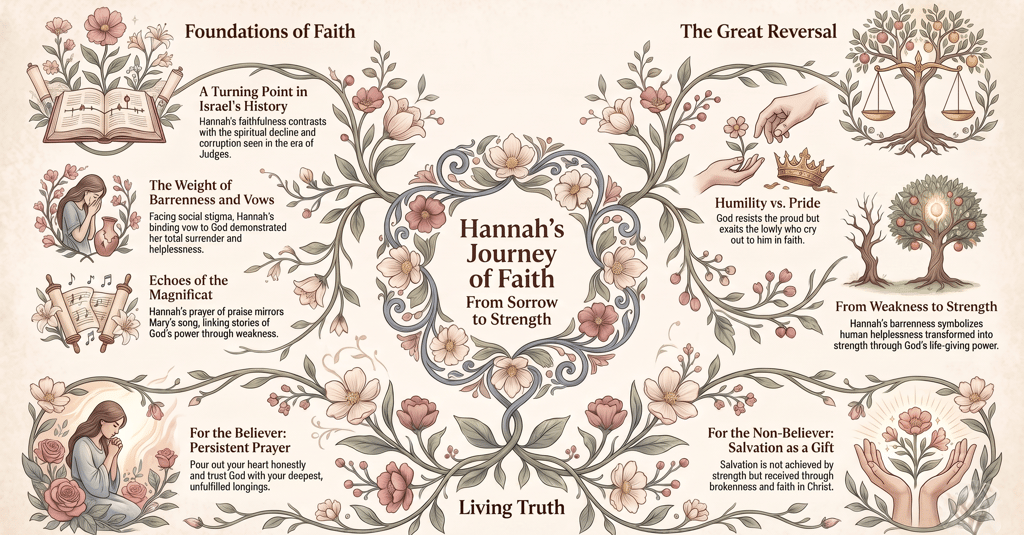
Preceding: Judges narrated that Israel was in spiritual decline and moral degradation (In those days there was no king in Israel. Everyone did what was right in his own eyes. Judges 21: 25).
Following: Samuel’s rise, Eli’s corrupt sons, from judges to kingship. Hannah’s faith contrasts with Israel’s unfaithfulness. Samuel’s birth begins God’s plan of renewal.
2.2 The historical context (circumstances of the author’s audience)
The audience lived in the period before Israel’s monarchial system was established. The priesthood was corrupt (Eli, Hophni, and Phinehas). The passage reassures that God is still at work in Israel’s darkest hour by rising up a new Priest, Prophet, and Judge in the life of Samuel.
2.3 The cultural context (details relevant to life as it was lived in this place at this time)
Barrenness carried a stigma
Vows to God were solemn and binding. Hannah’s vow showed total surrender and cry for help to the Lord.
Dedication of Samuel to temple service echoes the Nazirites.
2.4 The Biblical context (citations/allusions or historical connections to other books that the author is making)
Genesis 21: Sarah’s barrenness and Isaac’s birth.
Genesis 30: Rachel’s prayer for children.
Luke 1: Mary’s Magnificat echoes Hannah’s prayer.
The passage links the stories of barren women who became central to salvation history, showing God’s power through weakness.
3. What is the main point the author is making an argument with his audience (in one short sentence)?
God exalts the humble and faithful, bringing life and salvation where there are weakness and despair.
4. How does this passage connect to the gospel of Jesus Christ? What part of the gospel is in view?
Hannah’s barren womb: symbol of human helplessness apart from God.
Samuel’s birth: the last judge in the history of Israel and ushers in the Davidic King, Jesus, being in David’s genealogy is the perfect King, Judge, and High Priest
5. What is the main point you want to emphasize to your audience (in one short sentence)?
When God’s people pour out their hearts in faith and humility to the Lord, salvation is brought that overturns human weakness and magnifies his glory.
6. How will you apply this lesson to your life?
6.1 Application for Christians
Pray honestly and persistently. God hears.
Trust God with your deepest longing; surrender yourself to his purposes.
Rejoice in God’s reversals: He exalts the lowly and strengthens the weak.
Worship follows God’s deliverance.
6.2. Application for non-Christians
Salvation is not achieved by strength but received as a gift.
Like Hannah, you can come before God in your brokenness. Salvation is found in God alone through the living perfect High Priest, righteous Judge, and reigning King Christ Jesus.
Devotional materials for this article are available for FREE. Click on the product links below.
Our Latest Products
If you find this post helpful and insightful, consider subscribing to our weekly newsletter, and receive exclusive deals and freebies!
hello@imsetapart.com
© 2026 Im Set Apart. All rights reserved.
Contact Us
Follow us